Skin-to-Skin for Intubated Patients
| Rainbow Babies & Children’s Hospital NICU asked for best practices around securing breathing tubes during skin-to-skin holding. Thank you to the members who shared their unit’s processes, responses have been collated below. | ||
| Email Address | Name | Response |
| anduin.anderle@draeger.com | Anduin Anderle, RN, ANCL-N | I am always keeping an eye out for devices that support Kangaroo Care. Some time ago I saw a mom with a vest similar to this while holding her preemie. It has a few areas to secure circuits. I am not sure if there may be others out there but I think this is probably safer than tape or pins. Kangarobe(tm) – Safer and easier kangaroo care in the NICU https://kangarobe.com/ |
| ashleyluckemd@gmail.com | Ashley | We don’t have a standardized mode just yet but have ordered Zaky Zaks for our unit after piloting it in a research study one of our fellows conducted. We’ve had such positive experience with them we are purchasing for wider use throughout our unit. I can give you Yamile’s contact information if you’d like to inquire about samples. |
| calivingston24@gmail.com | Charlene A Nauman | Tape to shoulder appears to be more secure than gown to me. |
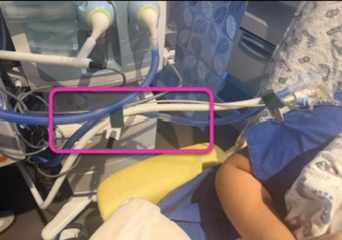
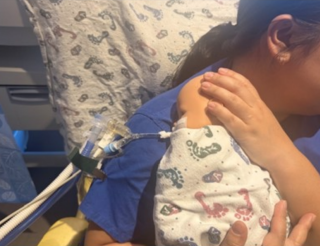
| ctay@memorialcare.org | Ching Ching Tay, MS, CNS, RNC-NIC, C-ONQS | We standardize STS in our intubated ELBW by having the furniture positioned in such a way that the baby is always facing the ventilator and using something called NeoGrip to hold the circuit and clipped to the holding parent’s gown. We have a very low incidence of unplanned extubation during STS. (See photos below) |
| dah9040@nyp.org | Dan | We use the clips with the velcro straps that wrap around the tubing, which is then clipped to a gown the parents can wear or wrap around the back of the chair. Parents can choose to do standing or sitting transfer. We made a video of standing transfer of intubated patients for parents and staff to watch prior to STS. We are a small Level III unit but we do take care of small babies. |
| daniela.machado@nhs.net | Daniela | Thank you for your email. That sounds like a very interesting project. Based on my experience, I can confirm that I am not familiar with a standard method. I have observed and used both tape and clips for securing, and I personally prefer using clips. |
| dawna.boudreaux@uhtx.com | Dawna Boudreaux MSN RNC-NIC, C-ONQS | We ensure that the tube is well secured, oral care has been completed so there are no extra secretions. We utilize the neogrip to hold cords and tubes and secure to the gown at the shoulder/upper arm. |
| edward@coopersteinhauserfoundation.org | Edward Steinhauser | As a NICU parent and what we have seen since doing our foundation work, it’s beneficial tape and clips (typically both). |
| gail.macrae@iwk.nshealth.ca | Gail | We secure the tubes to the gown! |
| jhilliard@angeleyehealth.com | JAYLEE HILLIARD, MSN, RN, NEA-BC, CPXP | As a parent, I received great feedback from nursing and RTs on the use of my Zaky Zak https://thezaky.com/collections/the-zaky-zak/skin-to-skin while holding with CPAP. It kept the tubing and my baby well secured. |
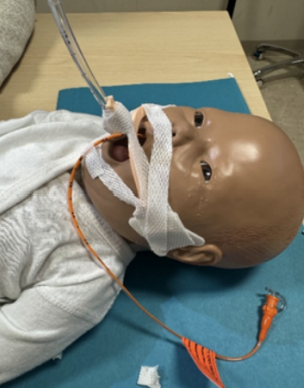
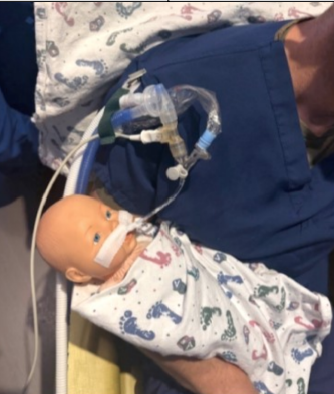
| mfrascon@montefiore.org | Melissa (Frascone) Cioffi, MSN RNC-NIC CNE | At Montefiore Medical Center’s Weiler NICU, our RTs and RN team work together to safely transfer the baby to the mother’s chest. All patients utilize the Neobar with 3M tape to keep the ETT stable. Then the NeoGrip velcro is used to secure the vent tubing to the mother’s shirt. Tape is also used to fasten the tubing to the mother’s shoulder and prevent adding extra weight to the patient’s face or kinking. We also use the “Zaky Zak” skin to skin wrap to secure the baby to the mother’s chest. This wrap is the only patented device that allows for “hands free” skin to skin. We found this zipper wrap prevents the patient from sliding down the mother’s chest. It doesn’t replace exercising caution and additional supervision with the nurse, but mother’s report it is more comfortable. They come in different sizes bast on the chest circumference. (See photo below) |
| misti@freearmcare.com | Misti Staley |
I’m happy that you emailed. This is a very important initiative. We have heard very similar discussions across NICUs regarding safely managing ETT positioning during early skin-to-skin and have hospitals that are currently utilizing the FreeArm to hold vent tubing. The FreeArm was designed for tube feeding and can also hold additional tubing. The interchangeable FreeArm pegs support gravity syringe tube feeding and other tubing in the incubator and the clamp adaptor secures the FreeArm to the chair for skin-to-skin time or to the open crib. This allows: The FeeArm can then be discharged home with tube feeding or vent dependent families or provided through their DME and billed to insurance, supporting nutritional compliance and caregiver confidence. Please learn more on our website here https://freearmcare.com/hospitals I’m happy to answer any additional questions. |
| kangarobe@gmail.com | Ruth Ann Crystal MD | We developed the Kangarobe specifically to address this issue. The Kangarobe provides a secure way to manage ETTs and other lines and tubes during kangaroo care in the NICU, with multiple anchoring points built into the garment so they can be safely supported on the parent rather than relying on ad hoc taping or clips. I’ve attached a photo from our Stanford study showing how the Kangarobe works. In that study, nurses and parents reported that the Kangarobe was safer, more comfortable, and easier to use compared to standard practice. We also observed faster transfer times to kangaroo care and parents held skin-to-skin for significantly longer (171 minutes per session with the Kangarobe vs.75 minutes with the standard of care). McMillin A et al. Reimagining Kangaroo Care for Preterm Infants: A Novel Garment for Safe and Comfortable Bonding. Children. 2024;11(11):1392. https://www.mdpi.com/2227-9067/11/11/1392 |
| yamile@thezaky.com | Yamile C. Jackson. PhD,PE,PMP |
Thank you for raising such an important and nuanced question, especially in the context of supporting early Skin-to-Skin (Kangaroo) Care for VLBW/ELBW infants. From an ergonomics, human factors, and safety engineering perspective, the key principle is managing relative motion between the baby, the airway, and the parent. In general, securing the ETT to the parent’s skin (e.g., chest or shoulder) tends to be the safest approach because any movement of the parent results in shared movement, the tube moves with the parent’s body rather than being subjected to differential forces. This can reduce the risk of traction at the airway. In contrast, securing the tubing to a gown or loose fabric introduces an additional variable. Because fabric can shift independently of the parent’s body, it may increase the risk of unintended pulling or micro-tension on the tube. I have also seen approaches where tubing is secured to the chair or external structures. While this may appear stable initially, it restricts natural parental movement. Over longer sessions, fatigue, repositioning, or muscle strain are inevitable, and this can stop a session or introduce higher risk as the parent adjusts against a fixed anchor point. That said, the method of securing the tubing cannot be separated from how the infant is positioned. These strategies are most effective when the infant is well-supported in a way that minimizes relative movement between the baby and the parent. Without that stability, even well-secured tubing can be exposed to shear or traction forces. For that reason, I would emphasize: |
Photos from Montefiore Medical Center & Memorial Care: