Help us support NICUs establishing policies that preserve milestones or ‘firsts’ for family caregivers.
***Milestones or ‘firsts’ can include first hold, first bath, first bottle, etc.
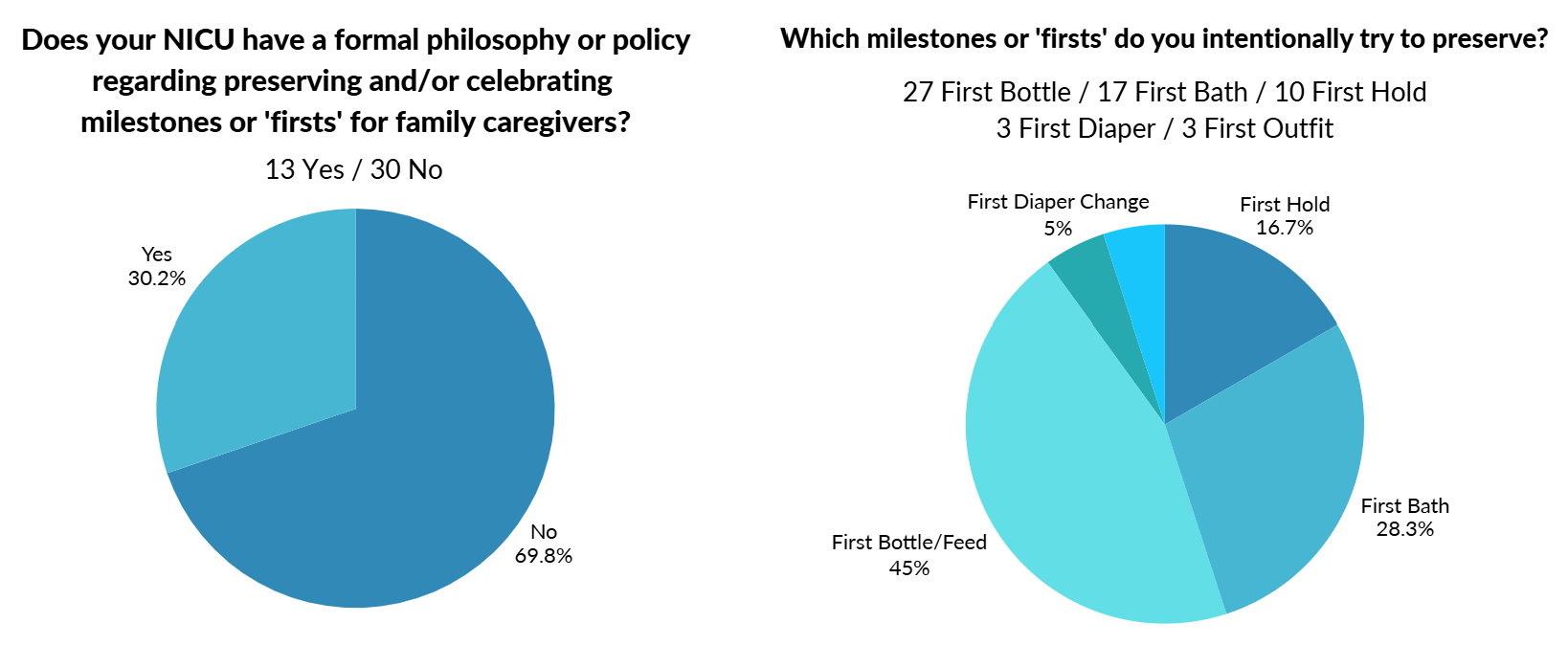
Which milestones or ‘firsts’ do you intentionally try to preserve?
***3 respondents answered first diaper change, 3 answered first outfit, and 1 answered first book
- We celebrate ours case-by-case and encourage families to take and date all of the milestone cards to celebrate the moment. We also offer to make custom cards which families love!
- We create footprint canvases for 1 month milestones.
- Depends on the nurse, some intentionally celebrate all, others do not.
- The only milestone we celebrate is the graduation day when the infant gets to go home.
- We try and preserve all the milestones; we just do not have a formal policy. We are getting ready to launch an all new “Road to Home” pathway that is a large keepsake for families.
- We celebrate weaning to room air, 100 days [of life], and due dates for every baby.
- We provide “story” bead bracelets for things like first hold, first bottle, moved to open crib, etc., but this is not a formal process.
- Weight milestones or corrected gestational ages, months old, reached room air, and off respiratory support on a case-by-case basis.
- [We celebrate] tasting milk from swabs of first pumped colostrum.
- The standard is parents do all milestones first whenever possible. I teach this in orientation, and it is established in unit culture that this is the norm.
- [We] use milestone cards for pictures; footprints to use with crafts and as milestones to show growth; “graduation ceremony” from small baby (under 28 weeks) unit and from NICU; use of a large white board sign to celebrate official leave from NICU upon discharge.
- We ensure that the first feed attempt is with mom and we call and schedule ahead of time. Our OTs and lactation consultants are fantastic partners in this!
How do you prepare family caregivers for the possibility that they may miss some milestones or ‘firsts’? How do you maximize caregiver participation when they cannot physically be present?
- We take pictures and leave them at the bedside on a case-by-case basis.
- We let families know that we are getting ready to start. With bottle feeding, our Feeding Therapist lets them know that we are going to start and the families are asked to present. Most do come. Everything we do is informed. As Family Support Specialist, I also ask the families what matters most, so we understand which “firsts” are important to them.
- Will communicate during their immediate visit.
- [We] schedule with family whenever possible. When unavailable we take pictures and create scrapbook pages.
- We don’t currently have a plan for this.
- Not sure we prepare them, [instead, we] respond in the moment. We try to take pictures for the families and OT/PT/SLP/CCLS leave them notes when they can’t participate.
- Validation is important. I think talking with families through the fact that there are many firsts that means something to people and some that don’t- it would be very hard to wait on a first diaper change as the babies may poop or pee at any given moment, etc.
- Most of our parents stay 24/7 in the private room, hospital bed, private bathroom, etc… if they plan to leave we make a plan about when they will return and if they want us to wait to do a bottle feed etc.
- We will provide families with regular updates about any upcoming changes and what they can expect in the near future. By keeping families informed in advance, we can give them a clear understanding of what is happening, provide adequate notice, and ensure they have enough time to prepare and adjust as needed.
- Discussing families’ desires of which firsts they want to be present for, attempting to uphold their wishes/delaying the first if it is not an urgent task, if parents cannot be there at the time then call them afterwards to let them know how it went.
- Instead of focusing on what was missed, we celebrate what has happened and plan for parent participation upon next need. Ex. first bottle, we let parents know of the next feed time and encourage them to be present.
- Open communication. By asking what is important to them FIRST, the teams can be informed and lead up to the event… ‘I’m not sure if you can be in tomorrow but it looks like we may be able to….. if you cant be here, how can we make this special for you…’ (where possible).
- I like to ask them if they want to be part of different milestone projects, or if they prefer to have staff leave them for them when they come in.
- I’m not sure this is done regularly. We do have a system for sending pictures.
- We do not have a specific way that we inform about missing firsts. We do have AngelEye cameras, but they are turned off for cares. So, we really don’t have a good way to do this.
- No standard process.
- We try and make sure we save moments for families but it’s not always possible. Also, sometimes a family’s first moment is one we haven’t anticipated.
- We let them know our plans and give them the option to try the first bottle. or we say SLP will offer first to evaluate and you can try next.
- We try to let them know when milestones are likely to happen and give them opportunities to be present. If not, we take pictures for the parents.
- For physical milestones like baths and feeds, they are not done without parental involvement.
- We use photos and cards.
- We use AngelEye cameras and can send pictures and videos. We also will FaceTime if dad comes to unit while mom is still recovering.
- We utilize AngelEye, and if parents want to be there for the first, we try to schedule that accordingly.
- We have a conversation during admission.
- We make sure when we see that a milestone is coming up it is discussed and a plan made so they can be there. If a caregiver has to miss it, we take photos, videos, make crafts for the wall, etc. We encourage video chats as well.
- Speak with family about realistic goals and family needs or desires.
- If they cannot be present, nursing will often help capture the moment or write the parents notes. We use the AngelEye camera to promote participation from afar.
- We talk with families on admission about goals and ways they can participate including items that are rated as very high/important to them. We routinely call to provide updates and engage families to be present as they are available including ensuring 24/7 access. We have not yet been successful in using cameras to allow them to see their baby when they’re not there.
- We discuss the NICU as an abnormal environment and try to celebrate each milestone as it occurs. We also have social work, child life, psychology, and a developmental care team to assist with supporting the family.
- Encouragement with everyday care.